 Earlier this week, Erica Friedman of ALC Publishing and Ozaku wrote a nice piece on the joys of talking manga on Twitter. I completely agree with her, and here’s an example: last night, as I was pondering this week’s license request, I knew I was in the mood for old-school shôjo, but which one? Fewer than 140 characters later, a wish-list ensued. There were plenty of perennial would-be favorites (like Osamu Tezuka’s Princess Knight and Riyoko Ikeda’s The Rose of Versailles), and lots that I’d never even heard of and now want, but one really caught my attention.
Wikipedia describes Paros no Ken (or The Sword of Paros) as a “yuri historical fantasy manga,” which is probably reason enough to want it in English. It was written by Kaoru Kurimoto, author of the Guin Saga novels (published in English by Vertical, along with one of its manga adaptations), and illustrated by Yumiko Igarashi, creator of the award-winning, lawsuit-triggering Candy Candy.
 The plot involves royalty, destiny, warfare, feminism, upstairs-downstairs lesbian romance, and lots of other nifty-sounding stuff in a relatively short three volumes, originally serialized in Kadakowa Shoten’s Monthly Asuka. In a shocking turn of events, it does not seem to be available in French, so if someone hurries, we might be able to beat them to the punch. The series seems to be out of print, but here are entries for the three volumes on Amazon Japan.
I’d try to go into more depth on Paros no Ken, but I can’t let all of those heartfelt tweets go to waste, so here’s a list of all of the titles people suggested with whatever links I could find:


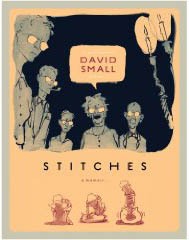 In the introductory paragraphs to the interview, Sasha Watson rather baldly summarizes some of the key events of Small’s early life that are portrayed in the book. I think that this is an unfortunate choice, as the power of the book lies in watching these events unfold in the way that Small has chosen to reveal them. For an autobiography, the structure and pacing of events is astonishing, as is the elliptical way Small contextualizes those events – the facts of them coupled with the truth of them, which are very different things.


 Okay, let’s flip back to page 261 for comics that interest me more viscerally, that is to say, comics that I’d actually like to buy. Drawn & Quarterly offers Imiri Sakabashira’s

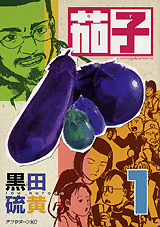 Leave it to Iou Kuroda to turn the ubiquitous, easy-to-grow fruit/vegetable into a manga series, Nasu, that I really, really wish someone would license and translate into English. It was originally serialized in Kodansha’s
 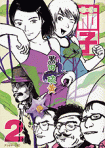 It was also published in French by
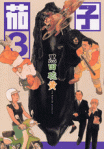 And
And 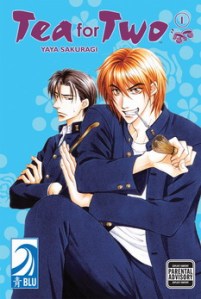 Tokumaru is a clumsy jock type. His sister reaches the breaking point with the breakage and insists he join their school’s tea ceremony club to “learn composure and grace if it kills [him]!” The club is run by stoic, dignified Hasune, who may have taken composure a little too far. Nobody who’s read a single chapter of a single yaoi title will be shocked to hear that these very different young men find themselves falling for each other, but Sakuragi does a nice job selling the notion that Tokumaru and Hasune are surprised, and pleasantly so.