The Manga Curmudgeon

Spending too much on comics, then talking too much about them

  • Home
  • About
  • One Piece MMF
  • Sexy Voice & Robo MMF
  • Comics links
  • Year 24 Group links

Upcoming 2/4/2009

February 3, 2009 by David Welsh

Let’s take a quick look at this week’s ComicList, shall we?

The undisputed pick of the week is obviously the fifth volume of Bryan Lee O’Malley’s Scott Pilgrim series, Scott Pilgrim Versus the Universe. It just is. In this penultimate volume, “Scott’s band is in total turmoil, his own exes have all boarded the train to crazy town, and Ramona’s evil exes have started appearing in pairs!”

During last week’s trip to the comic shop, I found myself without much in the way of purchases, so I wandered around looking for something out of the ordinary (for me, at least). Having heard so many good things about Jeff Parker’s writing on super-hero comics, I decided it was safe to pick up the collection of his Agents of Atlas (Marvel) mini-series, and it was a lot of fun. (I’ll post a longer review in a couple of days.) This week, Marvel launches an ongoing series with the characters, also called Agents of Atlas, and while I’ll pass on the monthly version, I’d imagine that, next year at this time, I’ll probably pick up the first trade. These things work in cycles.

My manga pick of the week is the 14th volume of Hikaru No Go (Viz), written by Yumi Yotta and illustrated by Takeshi Obata. This series was included in the recent Great Graphic Novels for Teens list for any number of good reasons – engaging story, well-developed characters, and terrific art.

Viz also releases two promising-sounding titles in its Shojo Beat imprint. Having read complimentary copies provided by the publisher, I’m forced to conclude that one of them should be meaner and the other should be smuttier.

Aya Kanno’s Otomen is about a sturdy young man with a secret. Under his sports-champion façade, his heart that beats only for the feminine things in life. He cooks, he sews, he devours shôjo manga, but he feels the need to hide these hobbies and be more traditionally masculine. When he falls for a pretty classmate, his girlish inclinations stage an all-out assault. Complicating matters is a third party who may have designs on the girl and who knows his rival’s secret passions. It’s a smart premise, but the characters are bland, and the story begs for some of the nasty edge that a creator like Takako Shigematsu might bring to it.

How delightfully bizarre is the idea of a high-school massage club? Much more delightfully bizarre than the reality of Isumi Tsubaki’s The Magic Touch, unfortunately. Maybe I just have stereotypical western ideas, but shouldn’t there be a few dirty jokes in a comic about a roomful of high-school students giving each other rubdowns? Or at least a few jokes about the utter absence of dirty jokes? Alas, there are none. Worse still, the narrative is all over the place, like the publication schedule for the series rapidly outstripped Tsubaki’s plans for it. And while the art is competent for the most part, if one of your plot points hangs on identical twins, shouldn’t they resemble each other? Imagine if this series had been done by Ai Morinaga.
Filed Under: ComicList, Marvel, Oni, Quick Comic Comments, Viz

Con Jobs II: This time, it's personal

February 2, 2009 by David Welsh

If you only do one thing at NYCC this year, buy a copy of My Mommy is in America and She Met Buffalo Bill at the Fanfare/Ponent Mon booth. If you only do two things at NYCC this year, attend “News Flash: Teen Girls Read Comics” on Friday morning, then score a copy of Buffalo Bill. Here’s the official description from the NYCC program:

The wider media still seems to be amazed that female readers are a huge part of the boom in the manga market, but while the stereotypical manga and anime fan has long been the male otaku, we know that women are making massive contributions to fandom, the industry, and beyond. This panel will discuss the state of women in the manga industry, female fans within the manga community, and just where we might go from here in supporting and advocating for the media we—both women and men—love.

I realize that this is old news for most manga fans, given the robust sales of Fruits Basket, Kitchen Princess, and Vampire Knight. But I still encourage you to attend, as I think the panel will be fun and thought-provoking, and will feature three of the smartest manga lovers I know: Brigid Alverson, Robin Brenner, and Tricia Narwani. The details:

Newsflash: Teen Girls Read Comics!
Friday, February 6th
10:15 – 11:15 AM
Room 1A24, Jacob Javits Center
Hosted by Brigid Alverson, Robin Brenner, Katherine Dacey, and Tricia Narwani

For a complete list of panels, screenings, and events at NYCC 2009, click here. Special thanks to Robin Brenner for organizing the panel and inviting me to participate—this is a genuine honor!

Filed Under: Conventions

From the "Belated" section

February 2, 2009 by David Welsh

For this week’s Flipped, I finally get around to taking a look at Yoshihiro Tatsumi’s The Push Man and Other Stories (Drawn & Quarterly), which is the most entertaining bummer comic you’re ever likely to read.

Filed Under: Drawn & Quarterly, Flipped

Manwha 100

February 2, 2009 by David Welsh

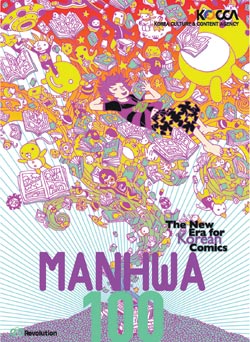
9781600099519As a reviewer, I’ve found Manga: The Complete Guide (Del Rey), Dreamland Japan: Writings on Modern Manga (Stonebridge Press), and Manga: 60 Years of Japanese Comics (Laurence King Publishing) indispensable references, whether I’m searching for information about a series’ publication history or looking for insight into a particular artist’s style. I hoped that Manhwa 100: The New Era for Korean Comics would provide a similar perspective on the Korean comics industry. Unfortunately, Manhwa 100 turned out to be an ambitious but poorly executed attempt to highlight the medium’s most popular, influential series.

In terms of organization and metholodgy, Manhwa 100 falls somewhere between Manga: The Complete Guide and Dreamland Japan, offering summaries of one hundred books, some of which have been translated into English. Each entry includes basic information about the series’ print run (e.g. number of volumes, magazine of serialization), its author, and its crossover into other media (e.g. videogames, television programs), as well as a plot summary and an assessment of the work’s artistic merit. Entries are grouped according to audience, with sections devoted to sunjeong (girls’) comics, boys’ comics, adult comics, and “webtoons,” comics that debuted online but were later anthologized in print.

We learn in the introduction that a committee of thirty industry professionals chose the books featured in Manhwa 100. The exact selection criteria are never satisfactorily explained, though it’s obvious the committee made a concerted effort to represent a broad spectrum of styles and subjects; no artist has more than one entry devoted to her work. Most books are of recent vintage, with only a smattering of titles released in the 1970s and 1980s.

And here I have a confession to make: I was sorely tempted to call my review “Manhwa 100: Cultural Learnings of Comics for Make Benefit Glorious Nation of Korea.” Why? The text is comically awful, awash in awkward phrases, grammatical errors, egregious typos, and ill-advised attempts to keep it real with slangy, conversational phrases that clash violently with the prevailing tone. The entry for Blue, a title by Lee Eun-hye, is typical of the book:

Comic book characters are used in many character merchandises now, but it was [sic] not very actively used in the 1990s. However, the comics of Lee Eun-hye were widely used in character merchandises, even in the 1990s. This is because the author has the knack of using colors as one of her main themes. As she said in her own words, “color in itself is a story.”

As she proclaims in Jump Tree A+, her previous work to Blue, the teenage years are the “Green Age.” Her new story, Blue, represents the young adult age. The color blue in the comic has two sides. It represents a bright fresh side of youth, and it also represents sadness and gloom. The twenty-somethings in the comic are both fresh and youthful, but at the same time lonely and nostalgic.

A rich man’s illigitemate [sic] son Seung-pyo, passionate dancer Hae-joon, his faithful follower Yeon-woo, smart but cold Hyun-bin, and strong charismatic rocker Ha-yun: Blue revolves around these five characters. The loneliness in Blue was sprouted from self-pity and narcissism. Like in many of her other comics, author Lee Eun-hye pushes her characters into their own narcissistic world disconnected from each other.

That is why Blue is beautiful. The earnest characters express their life honestly. And the poetic narration and symbolic monologues add to its beauty. In 1997, an OST disc, inspired by the comic, was…

Yes, the entry really does end with an incomplete sentence.

If I’m reading the text correctly, this confusing verbiage could be boiled down to three talking points: (1) Lee’s manhwa was among the first to inspire “character goods” (phone cards, figurines, stationery, keychains, etc.); (2) her books feature beautifully drawn, emotionally stunted characters; and (3) her books are popular enough to be adapted into TV shows, CD dramas, and the like. Though it’s obvious she views color as a metaphor for age and mood, it’s not clear how or if she uses color in her work—a crucial point, given the increasingly important role that color is beginning to play in manhwa. It’s also unclear what distinguishes Lee’s work from other sunjeong titles, as symbolism, emotionally-charged conversation, and interior monologues are staples of the medium, not personal idiosyncrasies.

If the book synopses are frustrating, the contextual essays are downright obtuse. With titles such as “Open a Manhwa Book, Become a Friend of Korea” and “Manhwa in America: The New World of Charms Yet to be Discovered,” their stilted language and boastful claims for manhwa’s international importance make them sound like Pravda articles. Anyone hoping for insight into the differences between manhwa and manga (or other sequential art traditions, for that matter) will be frustrated by the maddeningly vague, jingoistic text which acknowledges stylistic similarities between manhwa and manga while arguing for significant differences in subject and approach. As manhwaga Lee Hyun-se explains:

While the Japanese samurai pulls out his sword for the completion of his skill, the Korean warrior draws his sword in revenge of his family or to fight against his or her sworn enemy. The Japanese hero walks the glorified path of the hero, which is as clear as the blood he spills, but the Korean hero trudges, stumbling upon his own defects.

Lee attributes the difference in approach to Korea’s lengthy history of occupation, contrasting it with Japan’s long period of isolationism and political intrigue. “The endless internal strife of the Japanese builds up a sense of hubris and elitism,” he argues, “while being on the defense instills a sense of humility and compassion for others… The hero of Japanese manga is ‘I’ while the hero in Korean manhwa is ‘We.'” It’s an interesting but flawed thesis, akin to suggesting that Howard’s End and Finnegan’s Wake are utterly different because one was written by a British imperialist and the other by a downtrodden Irishman. Lee seems to forget that avenging one’s family (or village, or sweetheart, or mentor) is one of the most basic manga plotlines, transcending genre and time period. He also overlooks the important role of community in manga; for every Lone Wolf, there are just as many characters who discover their purpose when they join a particular group, whether it be the school council (a la Love Master A) or the Shinsengumi (a la Kaze Hikaru).

Given Manhwa 100‘s limitations, I’m reluctant to recommend it; anyone hoping for an indispensable reference or an introduction to Korean comics will find this book baffling. For those already enchanted with manhwa, however, I’d suggest reading Manhwa 100 in the same spirit that our grandparents and parents flipped through the Sears Roebuck catalog: as a book of possibilities, a wish list for readers who enjoyed Shaman Warrior, One Thousand and One Nights, Bride of the Water God, or Dokebi Bride. I’ve already spotted dozens of great candidates for licensing, from Be Good, a comedy about a gangster who goes back to high school at 40, to Buddy, a sports drama set inside the ultra-competitive world of women’s golf.

POSTSCRIPT, 2/3/09: I corresponded with the editorial staff at NETCOMICS, who explained that they had a contract with the Korea Culture and Content Agency (KOCCA) to distribute Manhwa 100 in North America. The book was written and produced by C&C Revolution, a private company. (No individuals are named as authors.) NETCOMICS is not responsible for the book’s editorial content, just for its distribution.

Filed Under: Netcomics

More results

January 31, 2009 by David Welsh

Deb Aoki revealed the results of two more reader polls over at About.Com this week.

In the Best New Seinen Manga category, Hiroya Oku’s ultra-violent Gantz (Dark Horse) took top honors, followed by Astral Project (CMX), written by marginal (also known as Garon [Old Boy] Tsuchiya) and illustrated by Syuji Takeya.

In the somewhat awkwardly titled Best New Classic or Reissued Manga category (though I can’t think of a more elegant way of phrasing it), Osamu Tezuka’s Black Jack (Vertical) comes out on top of a strong pack of contenders. Second place went to the VizBig editions of Takehiko Inoue’s Vagabond.

Update: I somehow missed the results from the Best New Josei Manga Poll, which are also posted. First place went to Tomoko Noguchi’s Object of Desire (LuvLuv/Aurora), with Kishi Torajiros’s Maka-Maka (Kitty Media/Media Blasters) claiming second.

Filed Under: Linkblogging, Polls

Con jobs: Fanfare/Ponent Mon

January 30, 2009 by David Welsh

In my ongoing effort to shamelessly favor nouvelle manga specialist Fanfare/Ponent Mon, I will share with you the publisher’s press release on its plans for the upcoming New York Comic-Con. If you attend the con, do yourself a favor and stop by Booth 2347 to browse and buy some really beautiful, unusual graphic novels. Or, y’know, don’t, and live forever with the nagging uncertainty of what might have been.

The release is after the cut.

FANFARE / PONENT MON PREVIEWS NEW RELEASES FOR 2009 AT NY COMIC-CON
BOOTH 2347 AT New York Comic-Con, Jacob K. Javits Center
FEBRUARY 6 – 8 2009
www.nycomiccon.com
www.ponentmon.com

Fanfare / Ponent Mon debuts their latest release for 2009 at New York Comic-Con! “My Mommy is in America and She Met Buffalo Bill” by Jean Regnaud and Émile Bravo will be available for sale at Fanfare / Ponent Mon (Booth 2347), as well as previews of the rest of the exciting new titles that are on the schedule for 2009.

Fanfare’s edition of “My Mommy is in America and She Met Buffalo Bill” is the first English edition of this award-winning French graphic novel. Printed in glorious full-color in a hardcover edition, this story is a touching remembrance of a 5-year old growing up in rural France in the 1970’s. Jean lives with his father, his younger brother and his nanny. As he starts school, he’s troubled by a mystery: Where is his mommy?

As the adults around him avoid his questions, his neighbor shares a secret. She gives him postcards written to him from his mother, all sent from exotic and far-flung destinations.

Get a taste of this touching and memorable book here: http://www.icv2.com/articles/news/13882.html. This book is suitable for readers age 10 and up, as well as grown-up readers who will be charmed by its slice-of-life storytelling and distinctive artwork.

“My Mommy is in America and She Met Buffalo Bill” has already earned these prestigious awards:

– Essentials Award winner, 35th Angoulême International Comics Festival, 2008
– Tam Tam Award 2008, Salon du Livres et de la Presse Jeunesse
– Émile Bravo was also a 2008 Eisner Award Nominee for his short story, “Young Americans” in Mome 8 from Fantagraphics

ISBN 978-84-96427-85-3
Hardcover, 120 full color pages
retail: $25.00
On sale in April 2009, and available for order now:
Diamond Comics Distributors, Previews code JAN094222 (service@diamondcomics.com / 800-45-COMICS)
NEW! Midpoint Trade Books (james@midpointtrade.com / 212-727-0190)

Drop by the Fanfare / Ponent Mon booth at New York Comic-Con and pick up copies of some of our recent award-winning and critically acclaimed releases, including

– Disappearance Diary by Hideo Azuma
– Quest for the Missing Girl by Jiro Taniguchi
– Japan as Viewed by 17 Creators
– The Walking Man by Jiro Taniguchi

You’ll also be able to preview some of the 2009 releases that are in the works, including:

– A Distant Neighborhood by Jiro Taniguchi
– Summit of the Gods by Jiro Taniguchi
– Korea as Seen by 12 Creators
– Years of the Elephant by Willy Linthout
– Spanish language editions

Filed Under: Conventions, Fanfare/Ponent Mon

In addition

January 30, 2009 by David Welsh

At Good Comics for Kids, Snow Wildsmith rounds up graphic novels recognized on other American Library Association lists like “Best Books for Young Adults” and “Quick Picks for Reluctant Young Adult Readers.”

One, the “Death and Dying” category in “Popular Paperbacks for Young Adults,” reminds me to ask a question: where’s Cyril Pedrosa’s Three Shadows (First Second) on any of these lists? I didn’t think it was a perfect book, but it was packed with sensitivity, ambition and craft, and it was a noble attempt at spinning a new fable.

Filed Under: Awards and lists, Comics in libraries, First Second, Linkblogging

From the comfort of my armchair

January 29, 2009 by David Welsh

Over at Good Comics for Kids, Brigid Alverson has opened up discussion on the recently announced 2009 Great Graphic Novels for Teens list. Instead of clogging up the GC4K comments section, I’ll just jot down some of my impressions here:

It’s good to hear that the Young Adult Library Services Association will be expanding the creator credits. (Tom Spurgeon noted the shortcoming yesterday.) Now I’m thinking that I should always make a point of identifying the translators and adapters who work on manga when I write about it at length (as opposed to the kind of drive-by references that are to follow in this post), as they certainly play an essential creative role.

I agree with Dirk Deppey’s dismissal of Life Sucks (First Second). When I saw the list, I briefly toyed with the idea of re-reading the book to see if it was as slapdash and movie-pitch cynical as I remember, but I’d rather devote my time to reading books that might be good as opposed to re-evaluating ones that I already think are bad.

Normally, the inclusion of a Green Lantern comic written by Geoff Johns would make me scratch my head in bafflement, but I’ve seen so many unexpected people say nice things about the book that I might actually have to plop down with a copy at Barnes & Noble and see what all the fuss is about. I’m not so curious that I’d buy one, because Green Lantern always bored me to tears, and my memories of Johns will always be [Edited to note: incorrectly] defined by Identity Crisis and that issue of Avengers where Hank Pym went spelunking, but I’d browse the trades that made the list.

I think one of Brigid’s starter questions, “Why is there only one book from DC’s high-end teen imprint Minx on the list, when much-neglected CMX scored a number of hits?”, answers itself, though not in a particularly kindly manner for Minx, so I’ll just say that I’m happy for CMX, particularly Yuki Nakaji’s Venus in Love.

I love that Junji Ito’s Uzumaki (Viz) made the list. Older teens are still teens. And when you figure that teens are probably the primary audience for dreadful garbage like the Saw movie franchise, at least someone is trying to point them towards good violent horror.

Oh, how I love Osamu Tezuka’s Dororo (Vertical). I know it shouldn’t be, but it’s probably my favorite translated Tezuka manga.

I need to stop dragging my feet and get a copy of The War at Ellsmere (SLG) by Faith Erin Hicks.

Filed Under: GGN4T

House… of HORROR

January 29, 2009 by David Welsh

Actually, I think it’s kind of cute. The Mainichi Daily News reports that legendary horror manga-ka Kazuo Umezu has won the right in court to paint his house however he likes. And when you consider the design choices he could have made…

Filed Under: Uncategorized

Safe Haven?

January 28, 2009 by David Welsh

Carnal Comics checked in the comments of a previous post with an update, noting:

“We are currently working an arrangement with Haven Distribution who sepcialize in carry the unique cutting edge comics. So we may still have a presence in the comic shop marketplace.”

Haven Distributors also came up this week in Rich Johnston’s Lying in the Gutters column at Comic Book Resources and in a wrap-up at Anime News Network. Newsarama’s Rick Offenberger interviewed Haven’s Lance Stahlberg earlier this week as well:

“Part of our mission is to help bring independent comics to the market. We give deserving titles a chance when Diamond won’t. We still have a submission and approval process, and you may get taken on consignment, but we boast a wide range of titles that cater to many tastes. Every new book we offer is treated the same.”

It would certainly be an interesting development if Diamond’s cost-cutting measures turned Haven into a major rival. Haven already seems like it’s in a good position for the “Offered Again” market sector.

Filed Under: Comic shops, Linkblogging

« Previous Page
Next Page »

Features

  • Fruits Basket MMF
  • Josei A to Z
  • License Requests
  • Seinen A to Z
  • Shôjo-Sunjeong A to Z
  • The Favorites Alphabet

Categories

Recent Posts

  • Hiatus
  • Upcoming 11/30/2011
  • Upcoming 11/23/2011
  • Undiscovered Ono
  • Re-flipped: not simple

Comics

  • 4thletter!
  • Comics Alliance
  • Comics Should Be Good
  • Comics Worth Reading
  • Comics-and-More
  • Comics212
  • comiXology
  • Fantastic Fangirls
  • Good Comics for Kids
  • I Love Rob Liefeld
  • Mighty God King
  • Neilalien
  • Panel Patter
  • Paul Gravett
  • Polite Dissent
  • Progressive Ruin
  • Read About Comics
  • Robot 6
  • The Comics Curmudgeon
  • The Comics Journal
  • The Comics Reporter
  • The Hub
  • The Secret of Wednesday's Haul
  • Warren Peace
  • Yet Another Comics Blog

Manga

  • A Case Suitable for Treatment
  • A Feminist Otaku
  • A Life in Panels
  • ABCBTom
  • About.Com on Manga
  • All About Manga
  • Comics Village
  • Experiments in Manga
  • Feh Yes Vintage Manga
  • Joy Kim
  • Kuriousity
  • Manga Out Loud
  • Manga Report
  • Manga Therapy
  • Manga Views
  • Manga Widget
  • Manga Worth Reading
  • Manga Xanadu
  • MangaBlog
  • Mecha Mecha Media
  • Ogiue Maniax
  • Okazu
  • Read All Manga
  • Reverse Thieves
  • Rocket Bomber
  • Same Hat!
  • Slightly Biased Manga
  • Soliloquy in Blue
  • The Manga Critic

Pop Culture

  • ArtsBeat
  • Monkey See
  • Postmodern Barney
  • Something Old, Nothing New

Publishers

  • AdHouse Books
  • Dark Horse Comics
  • Del Rey
  • Digital Manga
  • Drawn and Quarterly
  • Fanfare/Ponent Mon
  • Fantagraphics Books
  • First Second
  • Kodansha Comics USA
  • Last Gasp
  • NBM
  • Netcomics
  • Oni Press
  • SLG
  • Tokyopop
  • Top Shelf Productions
  • Vertical
  • Viz Media
  • Yen Press

Archives

Copyright © 2026 · Genesis Framework · WordPress · Log in